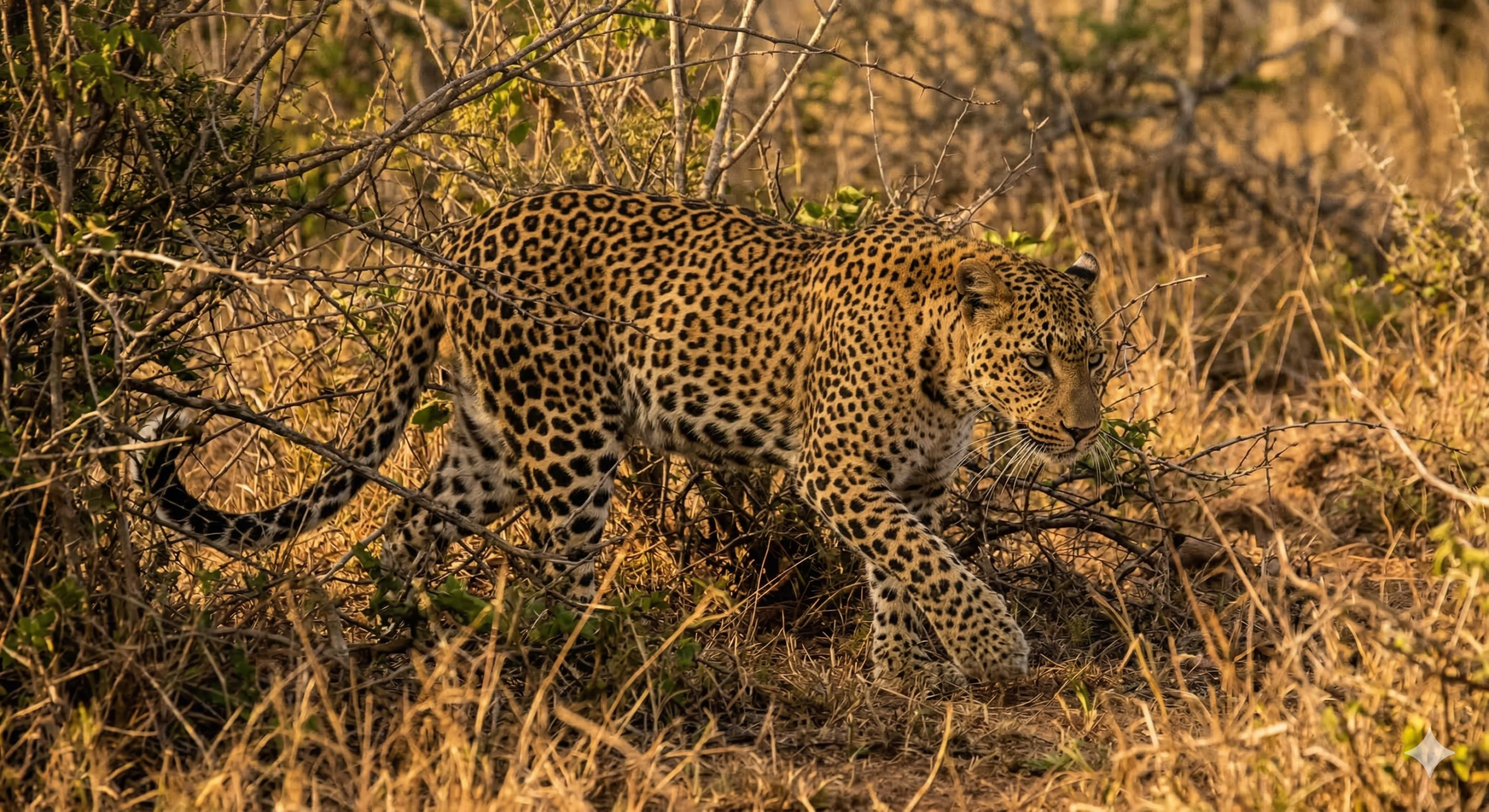
Yala National Park, a vibrant jewel in Sri Lanka’s wildlife crown, is perhaps best known globally for a spectacular and dangerous predator: the Sri Lankan Leopard (Panthera pardus kotiya). This specific subspecies, found only on this teardrop island, has made the unique scrub jungle and monsoon forests of Yala its premier stronghold. While leopards exist in other parks, the density and visibility within Yala make it the destination for catching a glimpse of this elusive master of shadows. For many travelers, spotting a Yala leopard, its spotted coat blending effortlessly into the golden scrub, is the absolute high point of their wild island adventure.
The Island Apex: A Kingdom Without Competition
In most continental ecosystems, leopards live in the constant, intimidating shadows of larger apex predators—tigers in India and lions in Africa. This forces them to be incredibly secretive, often hauling kills high into trees for safety. In Sri Lanka, however, there are no tigers and no lions. This geographic anomaly changes the very nature of the island’s leopard. The Sri Lankan Leopard, unfettered by competition, has expanded its role to become the undisputed King of the Lowlands. They are larger, bolder, and more comfortable patrolling their territories on the ground than their mainland cousins. While still secretive, this confidence makes them relatively easier to spot, reinforcing Yala’s reputation for world-class sightings.
Masters of Camouflage: Life in Yala’s Shadows
Yala’s unique landscape is the canvas upon which the leopard paints its life. The park is a mosaic of habitats: dense monsoon forest, open grasslands (palu trees), brackish lagoons, and, crucially, vast stretches of semi-arid scrub jungle. This specific scrub, characterized by tangled thorn bushes and golden-brown textures, is the perfect sanctuary. When a leopard lies motionless on a fallen palu trunk or even a seemingly open sand path, its spotted coat melts into the dappled sunlight and shadow. It is a true master of camouflage, a ghostly presence that might be just feet away, invisible until the flick of an ear or the flash of an eye betrays its location. Their preferred prey here includes Spotted Deer (Chital), Wild Boar, and small mammals, which they hunt with lethal precision and speed.
The Heart of Leopard Territory
Yala is divided into five massive, distinct ‘Blocks,’ but when people speak of “Yala,” they are usually referring to Block 1, also known as the Ruhuna National Park. This section, bordered by the Indian Ocean on one side, is renowned for having one of the highest leopard densities in the entire world. Block 1’s concentrated network of waterholes, lush grasses that attract deer, and rocky outcrops (poyas) provides the optimal habitat for these predators. It is within this specific matrix of food, water, and cover that dozens of resident leopards establish their distinct, tightly packed territories, making every turn of the safari jeep a potential encounter with greatness.
The Safari Experience: The Thrill of the Spotted Coat
The quest for the Yala leopard is an adrenaline-fueled experience. Safaris begin at the two main gates, typically at dawn or late afternoon (golden hour), maximizing the chance of seeing predators moving. The experience involves strategic driving, listening for alarm calls from deer or monkeys, and, most frequently, patience. A sighting can be spectacular—a leopard draped lazily on a large rocky outcrop, or terrifying—a silent stalk through the grass, culminating in a powerful burst toward prey. Due to the high density in Block 1, sightings are frequent, sometimes even multiple different animals on a single drive. However, Yala’s popularity means that peak hours can be chaotic, with many jeeps converging on a single sighting, emphasizing the need for ethical wildlife viewing and supporting operators who respect the animals’ space.
A Plate That Tells a Story
Sri Lankan Rice and Curry is a celebration of the island’s bountiful nature and its rich cultural tapestry. Every single plate is a masterpiece, a beautifully orchestrated symphony of flavors and textures that has been perfected over centuries. It’s a meal that is shared with family, offered to guests with pride, and enjoyed by everyone. To experience Rice and Curry in Sri Lanka is not just to eat a meal; it’s to connect with the very soul of the island, to understand its history, and to appreciate the profound love that Sri Lankans have for their food. It is truly the heartbeat that sustains, connects, and defines this beautiful island nation.