As the sun sets over the island, painting the sky in deep shades of indigo and orange, a transformation takes place in towns across Sri Lanka. The air, once filled with the scent of the ocean and tropical flowers, becomes heavy with the irresistible aroma of spices, grilled meats, and hot griddles. The rhythmic clack-clack-clack of metal blades slicing through roti echoes through the streets. This is the world of “Short Eats,” late-night cravings, and the unmissable, theatrical phenomenon that is Kottu. From the bustling corners of Colombo to the quiet beachfronts of Galle and the vibrant markets of Jaffna, Sri Lankan street food is a sensory overload and a journey into the heart of the island’s culture.
Kottu, the King of Street Food
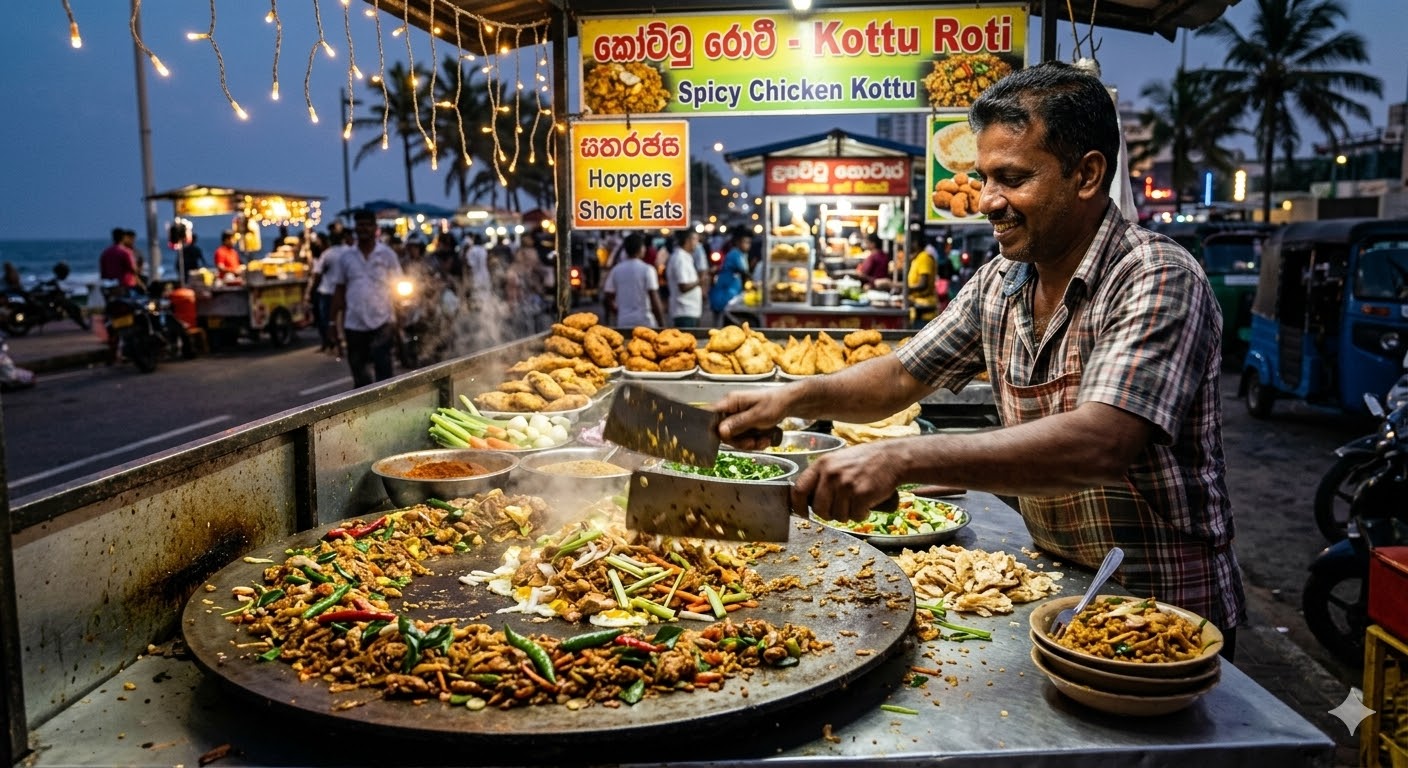
Kottu (or Kottu Roti) is the undisputed King of Sri Lankan street food. It’s not just a meal; it’s a dynamic performance. You don’t just eat Kottu; you watch it, listen to it, and experience it. As night falls, vendors (known as ‘Kottu Basses’) prepare this iconic dish on large, circular iron griddles, heated by open flames.
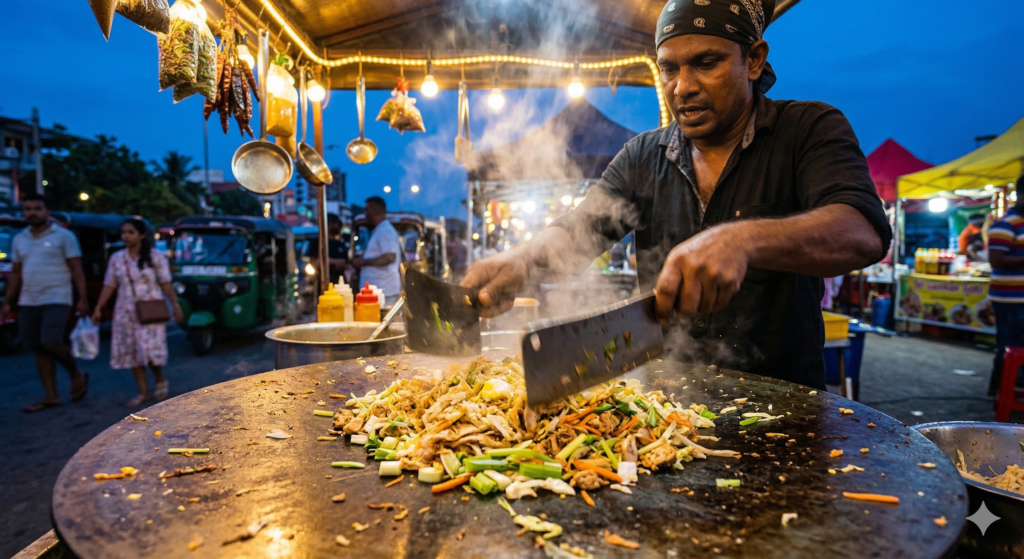
The preparation is a theatrical spectacle:
- The Base: It begins with ‘Godhamba Roti’—a soft, multi-layered, and very stretchy flatbread. This roti is made from a dough that is stretched exceedingly thin, often thrown and spun with dramatic flair, and then cooked on a hot griddle with plenty of oil, resulting in a slightly crisp, yet elastic texture.
- The Chop: This is the defining moment. Using two sharp, heavy metal cleavers or scrapers, the vendor methodically and vigorously chops the cooked flatbread, vegetables (leeks, carrots, onions, cabbage), eggs, and your choice of protein (chicken, beef, fish, or vegetarian cheese/egg combinations) with lightning speed.
- The Sound: This precise, incredibly loud clack-clack-clack or thwack-thwack-thwack is the heartbeat of Sri Lankan nightlife. It’s a rhythmic pulse that draws hungry passersby like a beacon, signaling that Kottu is being made.
- The Blend: As the chopping continues, various spices, oils, and a fiery, complex curry sauce (‘Kodi’) are added to the griddle. The vendor dexterously mixes and scrapes the entire mixture, ensuring every bite is infused with a rich, smoky, and spicy flavor.
Kottu is the ultimate, late-night comfort food, typically served hot and piping, often shared among friends, and followed by a tall glass of frothy, sweet milk tea. Its unique, smoky, slightly caramelized, and spicy taste is a flavor you’ll crave long after you leave the island.
Appa (Hoppers), the Elegant Rice Crêpe
If Kottu is the rough-and-ready king, then Hoppers (or Appa) are the elegant queen of Sri Lankan street food, especially prevalent during breakfast and the early evening. These bowl-shaped, slightly fermented rice flour crêpes are a masterpiece of texture and balance.
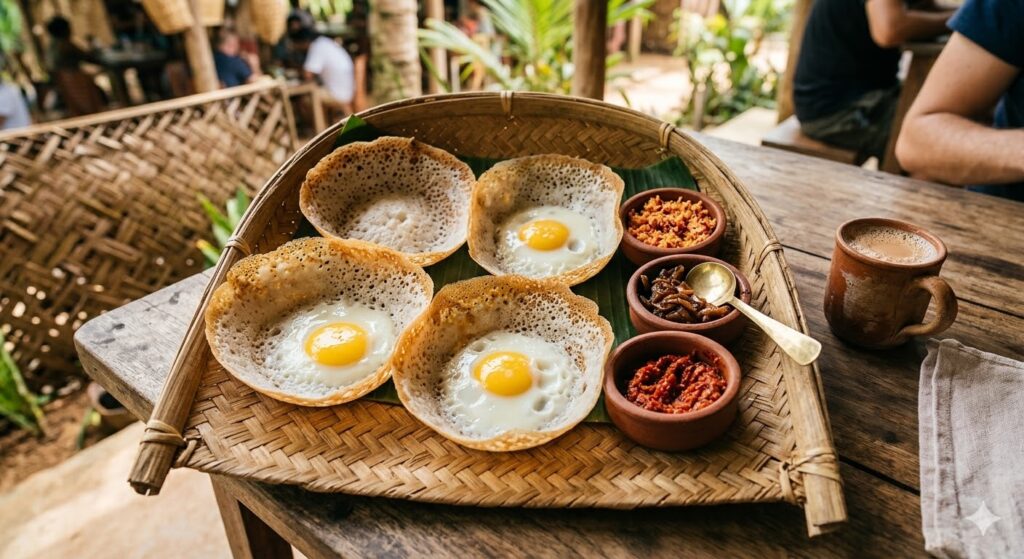
Hoppers are made from a batter of ground rice flour, coconut milk, and a tiny bit of yeast (or kallu, fermented palm sap, traditionally). The batter is poured into a special, small, high-walled, wok-like pan known as a thachchiya. The vendor deftly swirls the pan, allowing a thin layer of the batter to cook up the steep sides, while a small pool collects at the bottom. The result is a Hopper with:
- Crispy Edges: The delicate, lacy, and exceedingly thin edges are beautifully golden and satisfyingly crisp.
- A Soft Center: The base, however, remains soft, fluffy, slightly spongy, and rich, owing to the higher concentration of the coconut-milk batter.
A standard plate typically consists of 3-4 Plain Hoppers. However, the most iconic and sought-after version is the Egg Hopper. Just before the Hopper is finished, the vendor cracks a whole egg into the soft center. The egg cooks gently—the white sets, while the yolk remains perfectly rich and slightly runny. It is often served with a fiery Pol Sambol (fresh coconut and chili relish) and a milder Seeni Sambol (sweet caramelized onion relish) for dipping. The contrast between the crunchy edges, soft base, and rich egg yolk is nothing short of sublime.
Another delightful variation is the Milk Hopper (Kiri Appa), which is sweeter, with an extra dollop of thick, rich coconut milk added to the center during the cooking process.
Short Eats: The Art of the Savory Bite
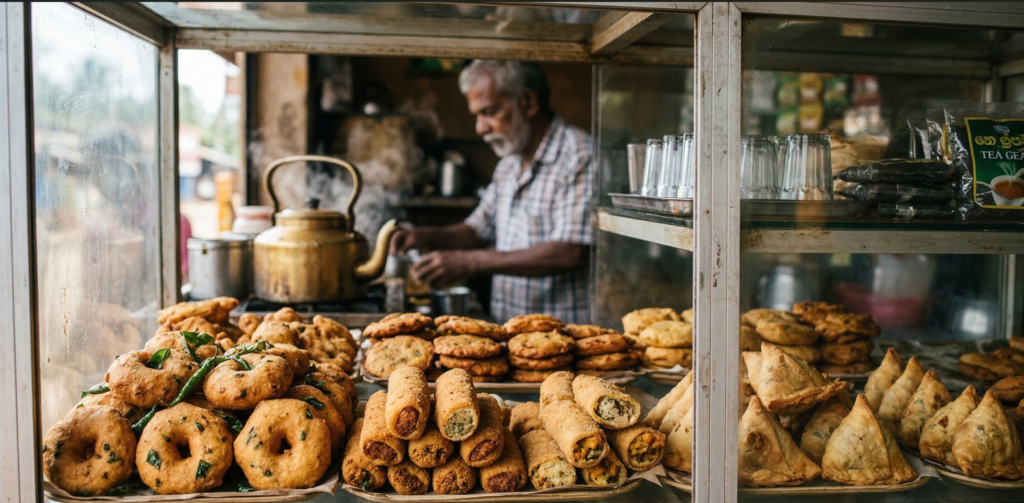
Beyond the main performances, Sri Lankan street food is characterized by a dazzling array of what locals call “Short Eats.” These are small, savory pastries, fritters, and snacks that are ubiquitous at bakery counters, tea shops, and roadside stalls (‘Thé Kadés’) throughout the day, particularly during mid-morning and late afternoon. Short Eats are the definition of convenience and comfort, often enjoyed with a casual cup of Ceylon tea or Kiri Thé (milk tea).
Some must-try Short Eats include:
- Fish Rolls: A savory, highly-seasoned mixture of flaked fish (often tuna) and spiced potatoes, rolled tightly in a crêpe-like pastry, coated in breadcrumbs, and deep-fried to a satisfying golden crunch.
- Wade (Lentil Fritters): These are perhaps the quintessential Indian Ocean snack. Made from split chickpeas (dhal) or other lentils, ground and mixed with chopped onions, curry leaves, and green chilies, then shaped into small patties (Ulu Wade) or doughnuts (Medhu Wade) and deep-fried until incredibly crispy on the outside and soft within.
- Samosas: A global classic, the Sri Lankan samosa typically features a slightly thicker, puffier pastry, often generously filled with spiced beef, chicken, or a hearty vegetable mix (potatoes, peas, carrots).
- Patties: Similar to Spanish empanadas, these are small, semi-circular pastries filled with spiced fish or vegetables, then either deep-fried or baked until golden.
- Chinese Rolls: Not actually Chinese, but a delightful hybrid, these feature a soft pancake (like a spring roll skin), filled with the classic spiced fish-and-potato mixture, rolled, and then deep-fried.
Short Eats are an incredibly diverse category, with vendors constantly innovating new fillings and shapes, making every stall worth a look.
Galle Face Green Staples: Sunset Snacks by the Ocean
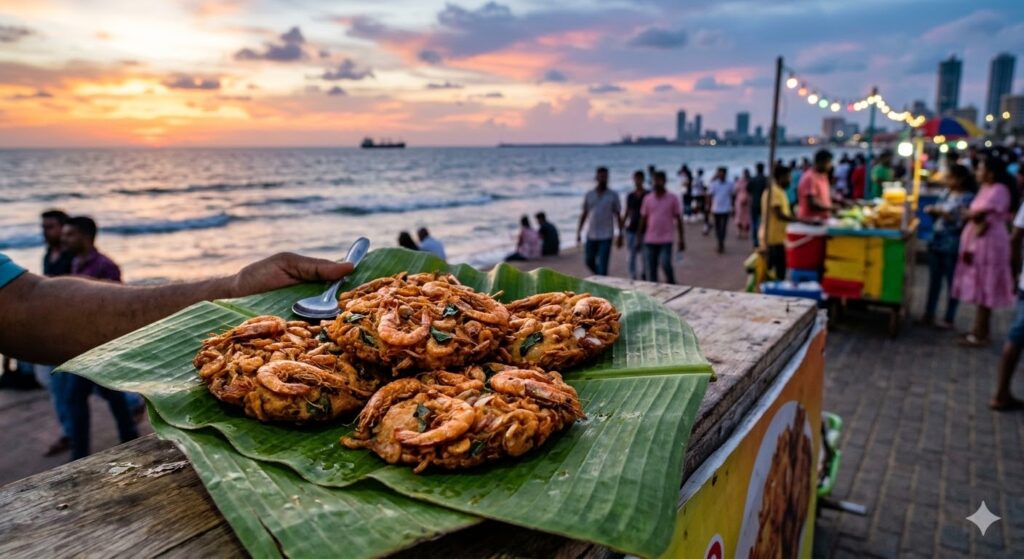
In Colombo, the most famous street food destination is Galle Face Green—a massive, historic promenade that stretches for half a mile along the Indian Ocean coast. As the sun begins to dip and the temperature cools, the Green comes alive, populated by families, friends, and dozens of food vendors selling unique snacks that have become Colombo staples.
While Kottu is available here, Galle Face Green is famous for a specific type of Short Eat and a particular seafood delicacy:
- Isso Wade (Prawn Fritters): These are the true stars of the Green. A base of lentils (similar to Wade) is shaped into a flat patty, and then 2-3 small, whole prawns (isso), often with their shells on for maximum flavor and crunch, are pressed into the top. The entire fritter is deep-fried to a deep golden-brown, making the prawns incredibly crispy. The result is a unique, crunchy, salty, and savory bite that is simply irresistible, especially when served hot and spicy with a squeeze of lime or a drizzle of chili sauce.
- Achcharu (Fruit Pickle): For a sweet-and-sour contrast, look for stalls selling Achcharu. These are various tropical fruits—green mango, pineapple, ambaralla (June plum), olive (veralu), and wood apple—which have been pickled in a fiery, sweet, and tangy brine of chili powder, salt, sugar, vinegar, and often Maldive fish (dried, cured tuna). The result is an explosive burst of flavor, often described as “love-it-or-hate-it,” that clears the palate and provides a welcome, refreshing zing in the tropical heat.
To experience Galle Face Green at sunset, Isso Wade and Achcharu in hand, with the cool ocean breeze on your face and the colorful lights of the food stalls reflected in the waves, is to understand the soul of Colombo’s street food culture.
The Soul on a Plate
Sri Lankan street food is more than just sustenance; it’s a vibrant, living library of the island’s culture, resilience, and unyielding love for flavor. Every clack of a Kottu cleaver, every swirling motion of a Hopper thachchiya, and every crisp bite of a Short Eat tells a story—of ancient traditions adapted for a modern pace, of diverse influences (South Indian, Portuguese, Dutch, British, and local Sinhalese and Tamil) blended with mastery, and of a people who find joy in shared meals and simple, delicious pleasures. To explore Sri Lanka’s street food is to truly connect with its people, understand its history, and embrace its passionate, fiery, and deeply comforting soul, served one delicious, spicy bite at a time.