Rising nearly 200 meters from the central plains of Sri Lanka, Sigiriya (the Lion Rock) is more than just a geological marvel. It is a masterclass in ancient urban planning, a gallery of 5th-century art, and a monument to a king’s ambition and paranoia. Whether you are a history buff or an adventurer, Sigiriya offers an experience that is as physically challenging as it is culturally rewarding.
The Legend of King Kashyapa: A Palace Born of Fear
The story of Sigiriya begins with a palace coup. In 477 AD, Prince Kashyapa seized the throne from his father, King Dhatusena, after a violent family dispute. Fearing the return of his half-brother Moggallana (the rightful heir), Kashyapa abandoned the traditional capital of Anuradhapura.
He sought the ultimate defensive position: the summit of a sheer granite monolith. For 18 years, Sigiriya served as a “castle in the sky,” until Moggallana returned with an army. Legend says Kashyapa’s war elephant turned during battle, leading his troops to believe he was retreating. Isolated and defeated, the king took his own life, and Sigiriya was eventually returned to the Buddhist monks who had occupied its caves for centuries.
The Royal Gardens: Symmetry and Hydraulic Genius
Before you even begin the climb, you walk through some of the oldest landscaped gardens in the world. These grounds are a stunning example of how ancient Sri Lankans mastered hydraulic engineering.
- The Water Gardens: A symmetrical network of pools, moats, and islands. Remarkably, the underground pressure-fed pipes still work today; during the rainy season, the limestone fountains still bubble to life.
- The Boulder Gardens: A stark contrast to the symmetry below, this area uses the natural landscape. Architects built pavilions directly onto massive boulders, using the rock’s natural cracks and surfaces as foundations.
- The Terrace Gardens: Rising in concentric circles from the base of the rock, these terraces were designed to provide cooling breezes and aesthetic beauty for the king as he descended from his summit palace.
The Mirror Wall and the Heavenly Maidens
Halfway up the rock, you encounter the Mirror Wall. Originally, this parapet was plastered with a mixture of fine lime, egg whites, and honey, then polished to such a high sheen that the king could see his reflection as he walked.
Today, the wall is famous for its Ancient Graffiti. Visitors from the 6th to the 14th centuries etched poems and impressions into the plaster. These “Kurutu Gee” (Graffiti Verses) are a treasure trove for linguists, showing the evolution of the Sinhala language.
Just above the wall, protected in a sheltered gallery, are the Sigiriya Frescoes. These vibrant 1,500-year-old paintings depict the “Cloud Maidens”—graceful women carrying flowers and jewels. While there were once reportedly 500 such figures, only 21 remain today, still glowing with their original pigments.
The Lion’s Paws: A Grand Entrance
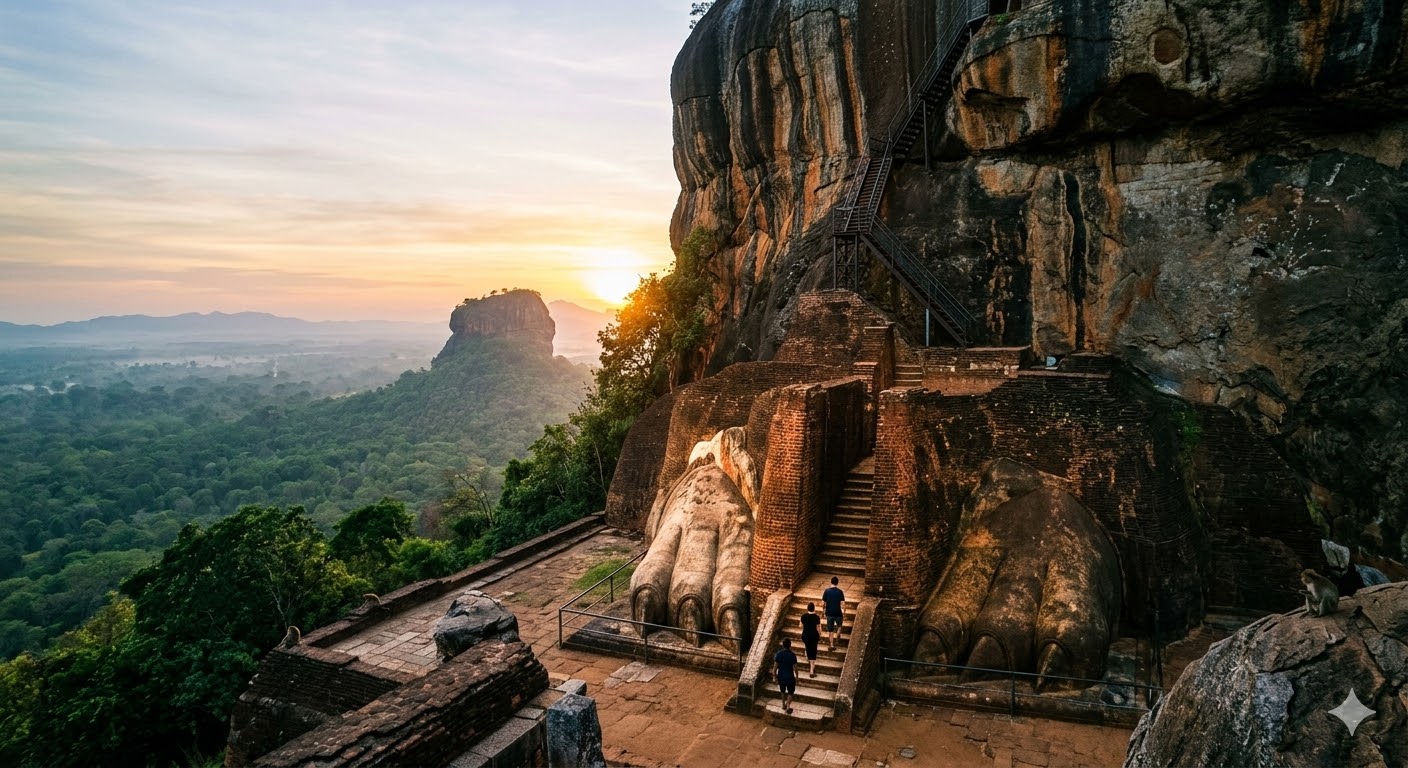
The final ascent begins at the Lion Platform. In its heyday, a colossal brick lion sat against the rock face, and visitors would enter the palace by walking into the lion’s open mouth.
While the head has long since crumbled, the two massive paws remain. Carved with incredible detail, the claws are taller than a human, serving as a humbling reminder of the scale of the original structure. From here, a narrow steel staircase clings to the sheer cliffside, leading you to the “top of the world.”
The Summit: A Palace Above the Clouds
Reaching the 1.6-hectare summit rewards you with 360-degree views of the emerald jungle. Here, the ruins of the upper palace complex unfold:
- The Royal Throne: A simple stone seat facing the sunrise.
- The Bathing Pool: A massive cistern cut directly into the solid rock that still holds rainwater.
- Urban Planning: You can clearly see the foundations of living quarters, audience halls, and defensive walls that once made this an impregnable city.
Practical Tips for Your Visit
- Start Early: Be at the gates by 7:00 AM. The tropical heat and the 1,200 steps are much more manageable before the midday sun.
- Hydrate: There are no shops once you start the climb, so carry plenty of water.
- Respect the Art: Photography of the frescoes is strictly prohibited to protect the ancient pigments from camera flashes.
- Watch the Monkeys: The local macaques are bold—keep your snacks tucked away in your bag!