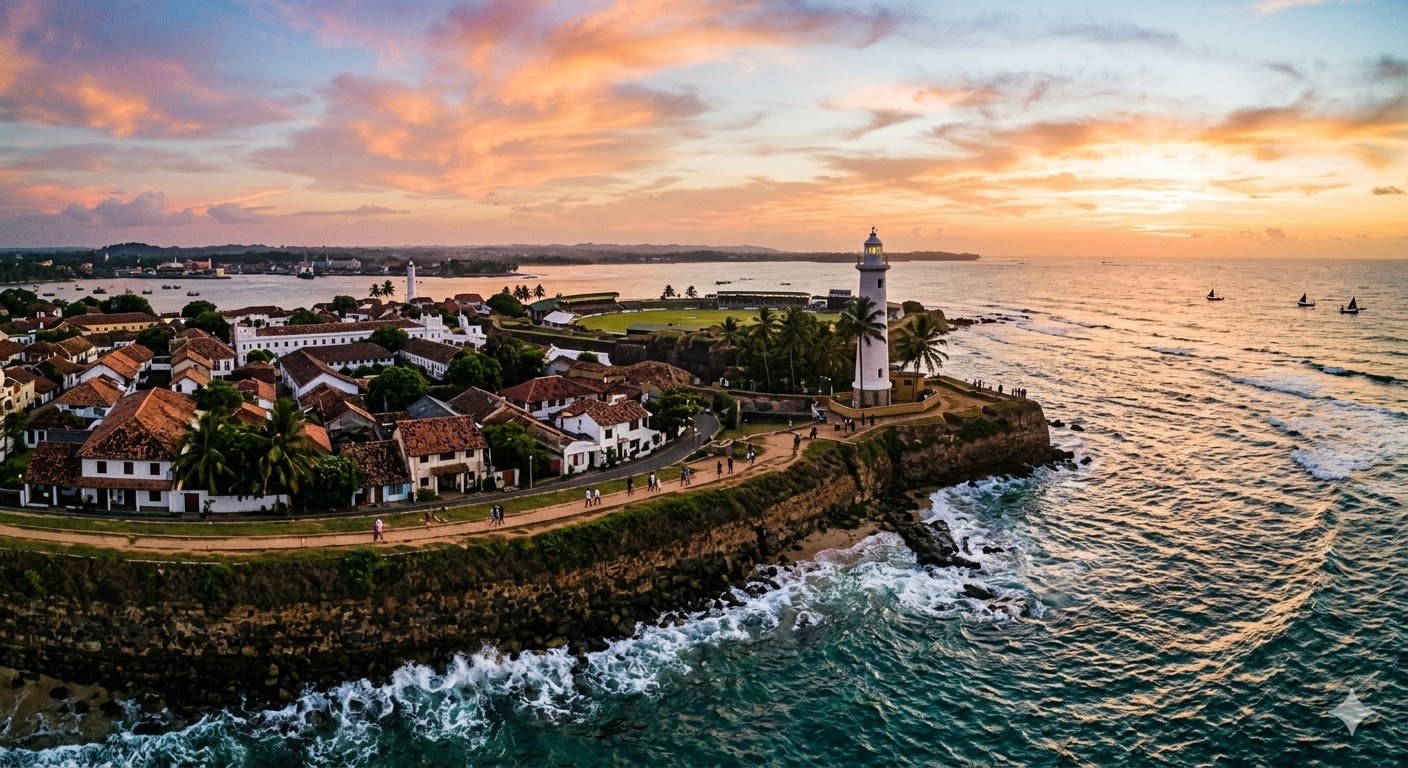
Located on a rocky peninsula in southwest Sri Lanka, Galle Fort is a mesmerizing intersection of history, culture, and coastal beauty. Originally founded by the Portuguese in 1588, the fort was heavily fortified by the Dutch in the 17th century. Today, it is a living, breathing UNESCO World Heritage site and arguably the most beautifully preserved colonial cityscape in all of Asia.
Galle Fort is not merely a museum piece; it is a vibrant community. The 90-acre complex, built around natural bedrock, is an entire city of ancient stone, bustling streets, and serene coast. Within its walls, the air is thick with the scent of spices, fresh seafood, and the salty Indian Ocean breeze. When people talk about a “Galle moment,” they are usually referring to this blend—where the raw power of the monsoon meets the elegant, mandated structures of a vanished empire.
The Ramparts: Walking the Wall
Galle’s most iconic feature is its imposing defensive walls. Stretching nearly three kilometers, the Ramparts are the heartbeat of the fort. These fortifications, built by the Dutch, saved the city during the 2004 tsunami, proving their strength centuries after they were mandated.
A walk along the ramparts is mandatory. Starting from the massive, double-arched Old Gate (still bearing the Dutch VOC emblem), you can walk all the way past the various bastions. The journey offers contrasting views: on one side, the intimate grid of ancient streets, and on the other, the turquoise expanse of the Indian Ocean. At the end, you reach the most famous section, the Galle Lighthouse, a beautiful, stark white sentinel that has guided ships for generations. Walking the wall at sunset, as the sky turns orange and the waves crash below, is one of the essential travel experiences in Sri Lanka.
Inside the Walls: Colonial Streets and Local Life
Step through the gates, and you enter a time capsule. Galle Fort’s grid pattern is perfectly mandated, but the life within is purely Sri Lankan. The narrow streets are lined with beautifully restored Dutch colonial villas, characterized by their high ceilings, deep verandas, and inner courtyards. These villas were mandated to be built by officers, and their elegance endures.
Today, these structures house an eclectic mix. You’ll find world-class art galleries, luxury boutique hotels, trendy cafes, and authentic local shops selling everything from brilliant blue sapphires to hand-woven textiles. Yet, amidst the tourism, local life thrives. You will see families gathered on verandas, the daily prayer calls from the Meera Mosque and the bells of St. Mary’s Cathedral and the ancient Dutch Reformed Church (built in 1752, featuring an intricate organ and an old pipe-and-bellows pulpit). This blend of Portuguese mandate, Dutch order, and vibrant local culture is the soul of Galle.
The Flag Rock Bastion: Galle’s Community Stage
While the Lighthouse gets the most attention, Flag Rock Bastion is where Galle’s community spirit truly shines. Located on the furthest point of the ramparts, Flag Rock was once used to signal incoming ships. Today, it is a grand, elevated plaza where locals and visitors gather.
By day, Flag Rock is a spectacle. It is famous for its cliff divers, brave local men who leap with practiced grace into the rocky, crashing waves below for the amusement of crowds. As the afternoon cools, the bastion transforms into a community stage. You will see families flying intricate kites in the ocean breeze, groups playing cricket on the adjacent Galle Cricket Ground (often visible from the walls), and vendors selling everything from freshly sliced mango with chili to sweet ginger tea. For the best “Galle moment,” buy a packet of fresh achcharu (pickled fruit), find a spot on the ancient stone, and watch the waves and the world go by.
A Plate That Tells a Story
Sri Lankan Rice and Curry is a celebration of the island’s bountiful nature and its rich cultural tapestry. Every single plate is a masterpiece, a beautifully orchestrated symphony of flavors and textures that has been perfected over centuries. It’s a meal that is shared with family, offered to guests with pride, and enjoyed by everyone. To experience Rice and Curry in Sri Lanka is not just to eat a meal; it’s to connect with the very soul of the island, to understand its history, and to appreciate the profound love that Sri Lankans have for their food. It is truly the heartbeat that sustains, connects, and defines this beautiful island nation.