Walls That Speak
Step into the dim, cool interior of a Sri Lankan rock temple, and you are immediately transported across centuries. As your eyes adjust to the low light, the walls begin to breathe with color—vibrant reds, earthy yellows, and deep greens depicting serene Buddhas, celestial maidens, and epic battles. Sri Lankan mural art is not merely decoration; it is a “visual scripture” that has served as a bridge between the divine and the devotee for over two thousand years. From the wind-swept heights of Sigiriya to the silent caves of Dambulla, these murals represent one of the most sophisticated and enduring artistic traditions in South Asia.
The Techniques of the Ancients
The survival of these paintings for over two millennia is a testament to the scientific ingenuity of ancient Sri Lankan artists. Unlike many Western frescoes painted on wet plaster, Sri Lankan murals often utilized a unique “tempera” or “fresco-secco” technique.
- Preparation of the Canvas: The rock surfaces were first leveled with a mixture of clay, lime, kaolin, and organic fibers like rice husks or animal hair to provide a flexible foundation.
- The Organic Palette: The colors were derived entirely from nature. Yellow and red ochre were sourced from the earth, green from crushed stones or plant extracts (like Ranawara), and black from charred coconut shells or soot.
- The Binding Secret: To ensure the paint adhered to the walls and survived the tropical humidity, artists used natural binders such as tree resin, plant gums, and even bee’s honey.
Sigiriya and the Golden Age of Realism
The 5th-century murals of the Sigiriya Rock Fortress stand as a pinnacle of Sri Lankan secular art. High above the jungle floor, in a sheltered pocket of the rock, the “Sigiri Apsaras” (celestial nymphs) hover among painted clouds.
- A Departure from Tradition: Unlike the predominantly religious themes found elsewhere, these paintings celebrate human beauty and royal grandeur. The ladies are depicted with jewelry, elaborate hairstyles, and flowers, captured with a fluid, free-hand stroke that suggests movement.
- The Mystery of Identity: Historians still debate whether these women represent the queens of King Kasyapa, lightning goddesses, or celestial beings. Regardless, their presence marks a moment where Sri Lankan art achieved a level of classical realism that rivaled the famous Ajanta caves in India.
The Jataka Tales and the Kandyan Revival
As the centuries progressed, the style of mural art shifted. By the 18th century, during the Kandyan Period, a distinct and highly stylized form of temple painting emerged.
- Continuous Narrative: The walls were divided into horizontal bands, telling stories in a “comic strip” fashion. These primarily depicted the Jataka Tales—stories of the Buddha’s previous lives.
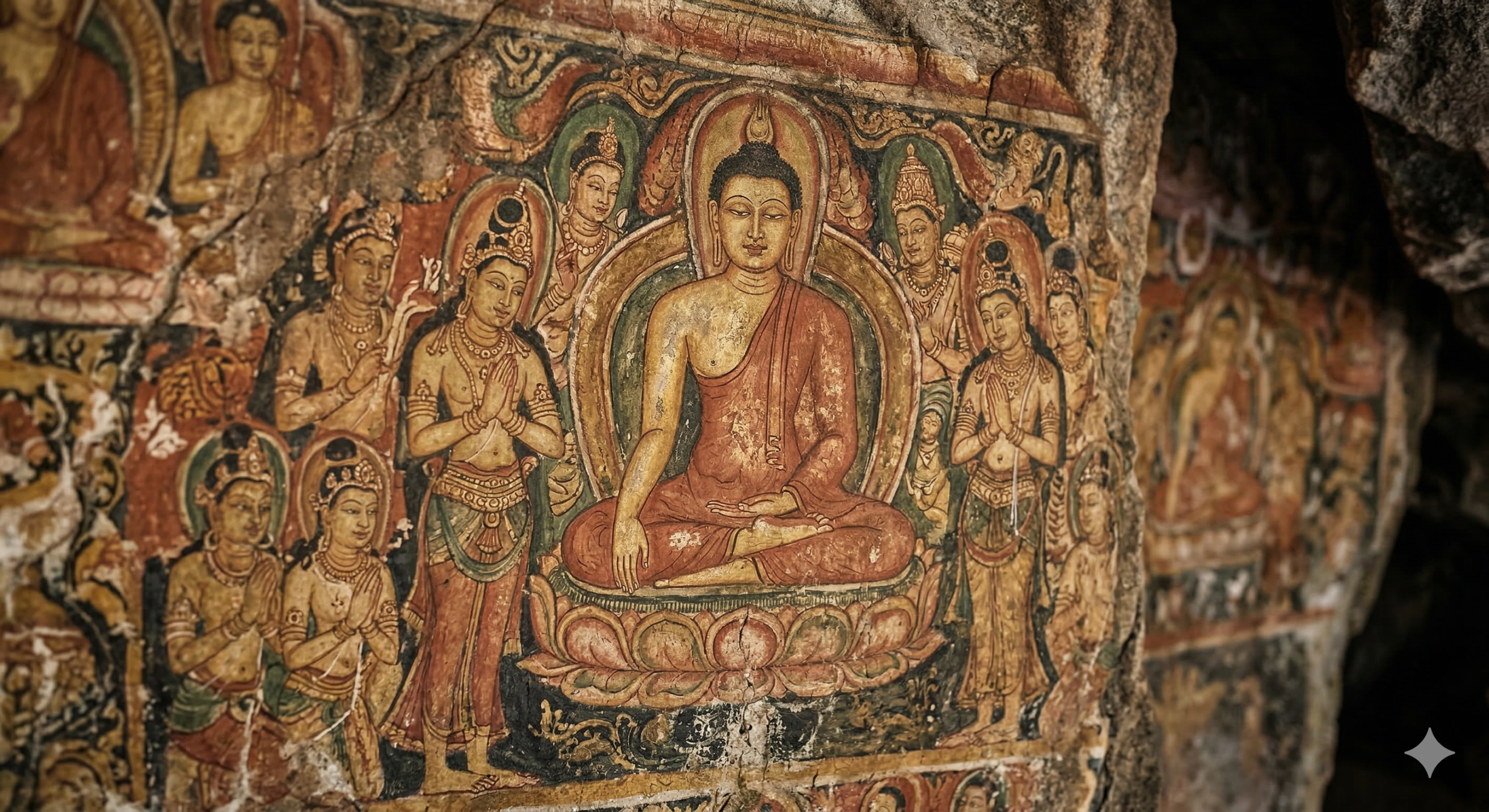
- The Aesthetic Style: Kandyan murals favor two-dimensional figures, bold outlines, and a lack of perspective. The backgrounds are often filled with motifs like the Pala Pethi (lotus petal) or the Liyawela (creeper vine), creating a dense, tapestry-like effect.
- Dambulla Cave Temple: This UNESCO World Heritage site is the grandest gallery of this style, housing over 2,000 square meters of painted walls and ceilings that create an immersive spiritual environment.
Symbolism and Spiritual Purpose
For the ancient pilgrim, these murals were not just art; they were a form of meditation.
- Mudras and Postures: Just as in dance, the hand gestures (Mudras) of the painted Buddhas convey specific meanings—fearlessness, teaching, or ground-touching (representing the moment of enlightenment).
- Aura of the Divine: The use of the Siraspata (the flame of rays emerging from the head) and circular haloes was a visual shorthand for spiritual energy.
- Preserving the Dhamma: In an age before mass literacy, these paintings made the complex philosophy of Buddhism accessible to everyone. By walking through a temple, a devotee could “read” the virtues of patience, sacrifice, and wisdom through the stories on the walls.